
Guppy Care Guide
Guppies are one of the most popular tropical fish in the world. Known for their bright colours, flowing tails and lively personalities, they are an excellent choice for both beginner and experienced fishkeepers.
At Friendly Fish Aquatics in Harlow, Essex, we regularly stock a wide range of colourful guppy varieties and have created this simple care guide to help you keep them healthy and thriving in your aquarium.
All of our guppies go through our quarantine process and are gradually acclimatised to local water conditions before being offered for sale.
Guppy Quick Facts
Scientific name: Poecilia reticulata
Common name: Guppy
Adult size: Around 3–5 cm
Temperature: 22–26°C
pH: Around 6.8–7.8
Water hardness: Moderate to hard
Temperament: Peaceful
Group size: Small groups of 4–6+
Minimum aquarium: Around 60 cm long
Diet: Omnivore
Swimming area: Upper and middle levels
Community suitable: Yes
Beginner suitable: Yes
Lifespan: Around 2–3 years
Overview
Guppies (Poecilia reticulata) are small, lively tropical fish famous for their incredible variety of colours and tail shapes.
Over many years of selective breeding, fishkeepers have developed dozens of different colour patterns, markings and fin styles. This means two guppy varieties can look completely different while still having essentially the same basic care requirements.
Guppies are peaceful community fish that remain active throughout the day, adding plenty of colour and movement to the upper and middle areas of the aquarium.
Their relatively straightforward care requirements, adaptability and willingness to accept a wide variety of foods make them particularly popular with people setting up their first tropical aquarium.
Identification
Guppies are small tropical fish known for their bright colours and flowing tails. One of the easiest ways to identify them is by the noticeable difference between males and females.
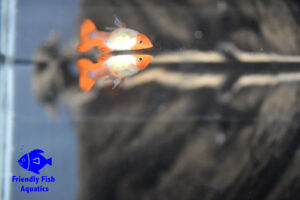
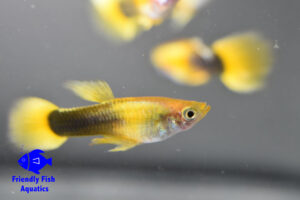
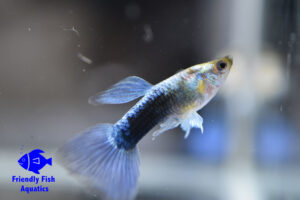
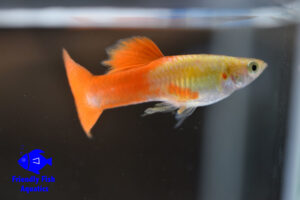
Male guppies are generally smaller and much more colourful. Depending on the variety, they can display reds, blues, yellows, greens and metallic colours, along with large decorative tail fins.
Female guppies are larger and usually have more subdued colouring, often appearing grey or silver with less elaborate fins.
Mature males can also be identified by their gonopodium, a modified anal fin used for reproduction. Females have a normal fan-shaped anal fin and may show a dark gravid spot towards the rear of the abdomen.
Because guppies have been selectively bred for many generations, they are now available in an enormous range of colours, patterns and tail shapes.
Tank Size
Guppies generally grow to around 3–5 cm, with females usually becoming larger and more heavily built than males.
An aquarium around 60 cm long or larger is a good starting point for a small group.
Although guppies are small, they are active fish and appreciate having plenty of swimming space. Larger aquariums also provide more stable water conditions and give you greater flexibility when creating a community of compatible fish.
A planted aquarium with open swimming areas works particularly well for guppies.
Water Conditions
Typical guppy care guidelines are:
- Temperature: 22–26°C
- pH: Around 6.8–7.8
- Water hardness: Moderate to hard
Guppies generally prefer harder, more mineral-rich water than many soft-water tropical species.
The guppies we sell have been gradually acclimatised to our local water conditions. This can make the transition into aquariums using similar local tap water easier than fish arriving directly from very different water conditions.
Stable water quality, regular maintenance and a properly cycled aquarium are generally more important than constantly adjusting the water in an attempt to achieve an exact pH value.
Natural Habitat
Wild guppies originate from northern South America and parts of the Caribbean, including areas of Venezuela, Guyana and Trinidad and Tobago.
They inhabit a variety of freshwater environments, including streams, pools and slower-moving waterways, often in areas containing aquatic vegetation.
The colourful fancy guppies seen in aquarium shops today have been selectively bred for many generations and can look dramatically different from their wild ancestors.
In the aquarium, they appreciate a combination of planted areas, open swimming space and good filtration.
Setting Up the Fish Tank
A well-designed guppy aquarium should provide a combination of plants and open swimming space.
Suitable easy-care plants include:
- Java Fern
- Anubias
- Cryptocoryne species
- Hygrophila
- Floating plants such as Amazon Frogbit
Plants provide cover, create a more natural-looking environment and can give young guppies somewhere to hide when males and females are kept together.
Good biological filtration and regular aquarium maintenance will help maintain the stable water conditions guppies need.
Diet & Feeding
Guppies are omnivores and readily accept a wide variety of aquarium foods.
A good-quality tropical flake or appropriately sized pellet can form the basis of their diet.
This can be supplemented with foods such as:
- Daphnia
- Brine shrimp
- Cyclops
- Small bloodworm
- Suitable vegetable-based foods
Offering a varied diet can help maintain good condition and strong colour.
Feed small amounts that the fish can comfortably consume rather than allowing uneaten food to accumulate in the aquarium.
Behaviour and Group Size
Guppies are active, social fish and generally do well when kept with others of their own kind.
They can be kept in male-only groups or in groups containing both males and females.
Male-only groups are particularly popular for colourful display aquariums because males usually have the brightest colours and most elaborate tails.
If males and females are kept together, expect them to breed. Guppies are livebearers and females give birth to free-swimming young rather than laying eggs.
Where both sexes are kept, having more females than males can help reduce persistent attention towards individual females.
Tank Mates
Guppies are peaceful community fish and can live alongside many other appropriately sized, non-aggressive species.
Suitable tank mates can include:
- Corydoras catfish
- Peaceful tetras
- Rasboras
- Kuhli Loaches
- Peaceful Gouramis
- Platies and other compatible livebearers
When choosing tank mates, consider water requirements as well as temperament. Guppies generally prefer moderately hard to hard water, so fish comfortable under similar conditions are particularly suitable.
Avoid large aggressive fish and species known for persistent finnipping, as the flowing tails of male guppies can make them vulnerable.
Popular Guppy Varieties
One of the biggest attractions of guppies is the enormous range of colours, patterns and tail shapes available.
At Friendly Fish Aquatics we regularly stock a changing selection of guppy varieties, which can include:
- Cobra Guppies
- Mosaic Guppies
- Tuxedo Guppies
- Dumbo Ear Guppies
- Grass Guppies
- Half Black Guppies
- Moscow Guppies
- Albino Guppies
- Endlers
Our selection changes regularly, so visiting the shop or checking our current stock is the best way to see which varieties are available.
Frequently Asked Questions About Guppies
Are guppies good for beginners?
Yes. Guppies can be an excellent choice for beginners when kept in a properly cycled and maintained aquarium. They are adaptable, readily accept prepared foods and are active, colourful fish.
How many guppies should I keep?
A small group of around 4–6 or more can work well. The exact number will depend on the size of the aquarium and whether you’re keeping males only or a mixture of males and females.
Do guppies breed easily?
Yes. Guppies are livebearers and are well known for reproducing readily. If mature males and females are kept together, you should expect eventually to see baby guppies.
What size aquarium do guppies need?
An aquarium around 60 cm long or larger is a good starting point for a small group.
Can guppies live with tetras?
Yes, but choose peaceful tetra species that are comfortable with similar water conditions. Avoid species known for fin-nipping.
Can guppies live with Corydoras?
Yes. Many Corydoras can make good companions for guppies, provided the species chosen is comfortable with the aquarium’s temperature and water conditions.
Can I keep only male guppies?
Yes. Male-only guppy groups are popular because they provide plenty of colour without producing fry. Make sure the aquarium provides enough space and cover for the fish to move away from one another if necessary.
Our Fishkeeping Tip
We find guppies look particularly impressive in planted aquariums where their bright colours contrast against green plants.
If you don’t want baby guppies, consider keeping a male only group. If you do keep males and females together, provide plenty of plant cover and be prepared for fry guppies can reproduce very readily.
About Our Fish
Fish sold at Friendly Fish Aquatics go through our quarantine process before being offered for sale. Our tropical fish shop in Harlow has more than 100 aquariums with individually filtered sales tanks, and we specialise in tropical community fish.
Looking for Guppies?
We regularly stock a wide selection of colourful guppies at Friendly Fish Aquatics in Harlow, Essex. Our fish are quarantined and acclimatised to local water conditions before being offered for sale.
Our guppy selection changes regularly, with different colours and strains available throughout the year.
See our Guppies currently in store, or visit us in Harlow to see the latest varieties and get advice on choosing suitable fish for your aquarium.